
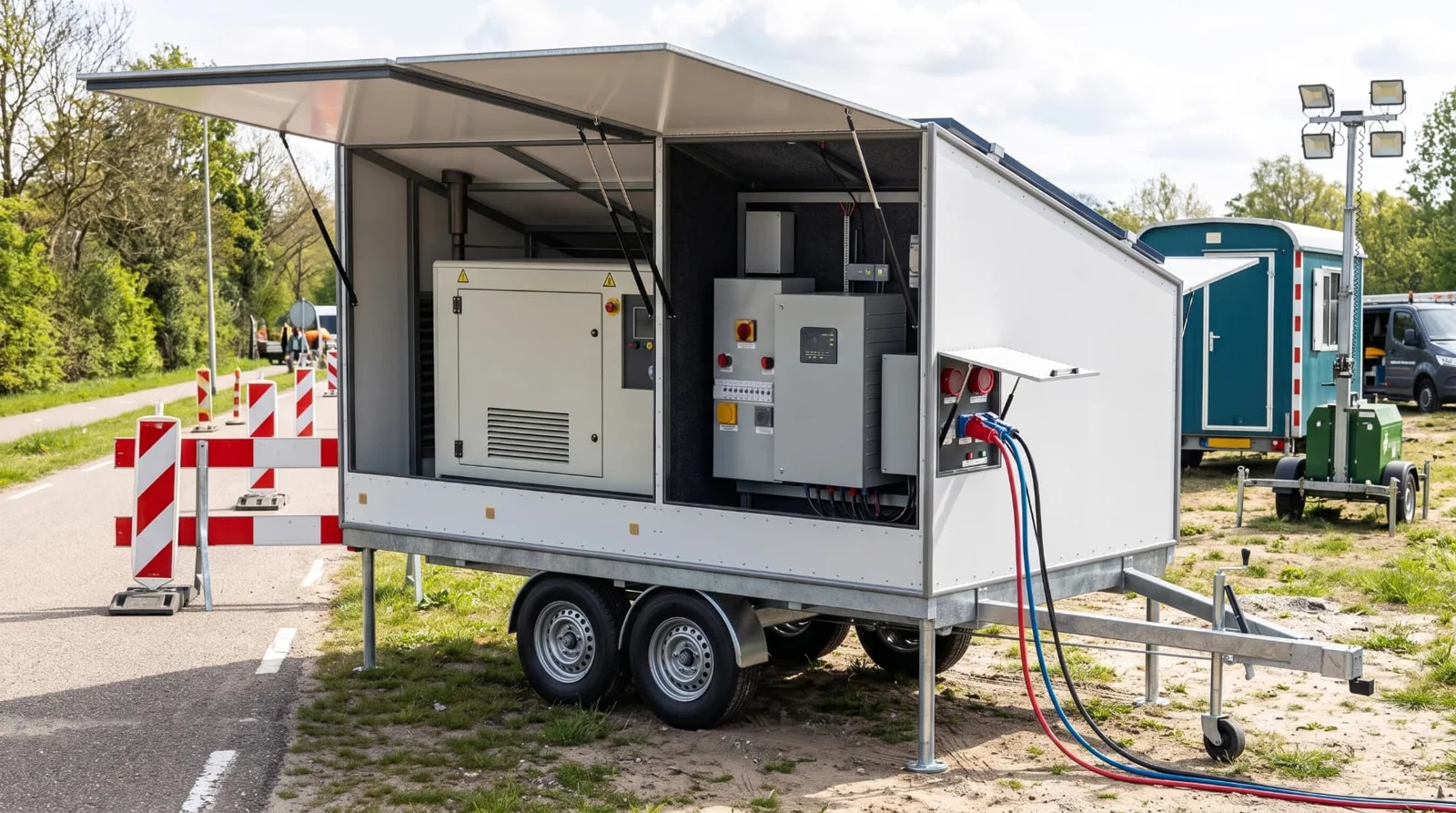
A week by the roadside without refuelling
Lighting, your site cabin and traffic control run around the clock. Solar power and the battery cover the day.
Does this sound familiar?
- 01Problem
Long projects at sites without a grid connection.
- 02Problem
Lighting, a site cabin and traffic control that must run around the clock.
- 03Problem
Refuelling trips that cost more than the electricity itself.
A day on site
Low power demand, but 24 hours a day. Solar power and the battery cover the day, with brief generator charging. Runs only on HVO100, biodiesel made from residual and waste fats. Most generators run on ordinary diesel.
- 00:00 to 04:00: Battery supplies power
- 04:00 to 06:00: Generator supports supply
- 06:00 to 24:00: Battery supplies power
- 08:00 to 17:00: Solar charges the battery
- Lighting, your site cabin and traffic control run on the battery, day and night.
- Solar power helps charge the battery during the day.
- Through 4G, we can see in advance when someone needs to visit.
Savings
Set for a typical job: 200 days per year, approx. 50 kWh per day. Adjust it for your work.
Assumption: generator rental € 140 per day (market price). We compare equal rental rates. For an owned generator we use the buying benchmark of approx. € 6,800 less per year, including depreciation and maintenance.
- Current rental, fuel and refuelling
- -
- Your annual savings with a Skidvolt
- -
- Generator running hours you save
- -
In this situation, you are better off renting or keeping your own generator.
Send me the calculationIt works even when parked
Between projects, you keep it at your premises. It stores solar power or low-cost electricity, covers peaks and provides backup power. Peak shaving, low-cost charging and solar storage at your premises can yield roughly € 1,500 to € 3,000 per year. Sometimes you avoid a grid connection upgrade. Tender points and quiet operation come on top: at approx. 100 kWh per day, the generator is off for 17 hours.
More battery capacity means longer roadside operation without a visit.